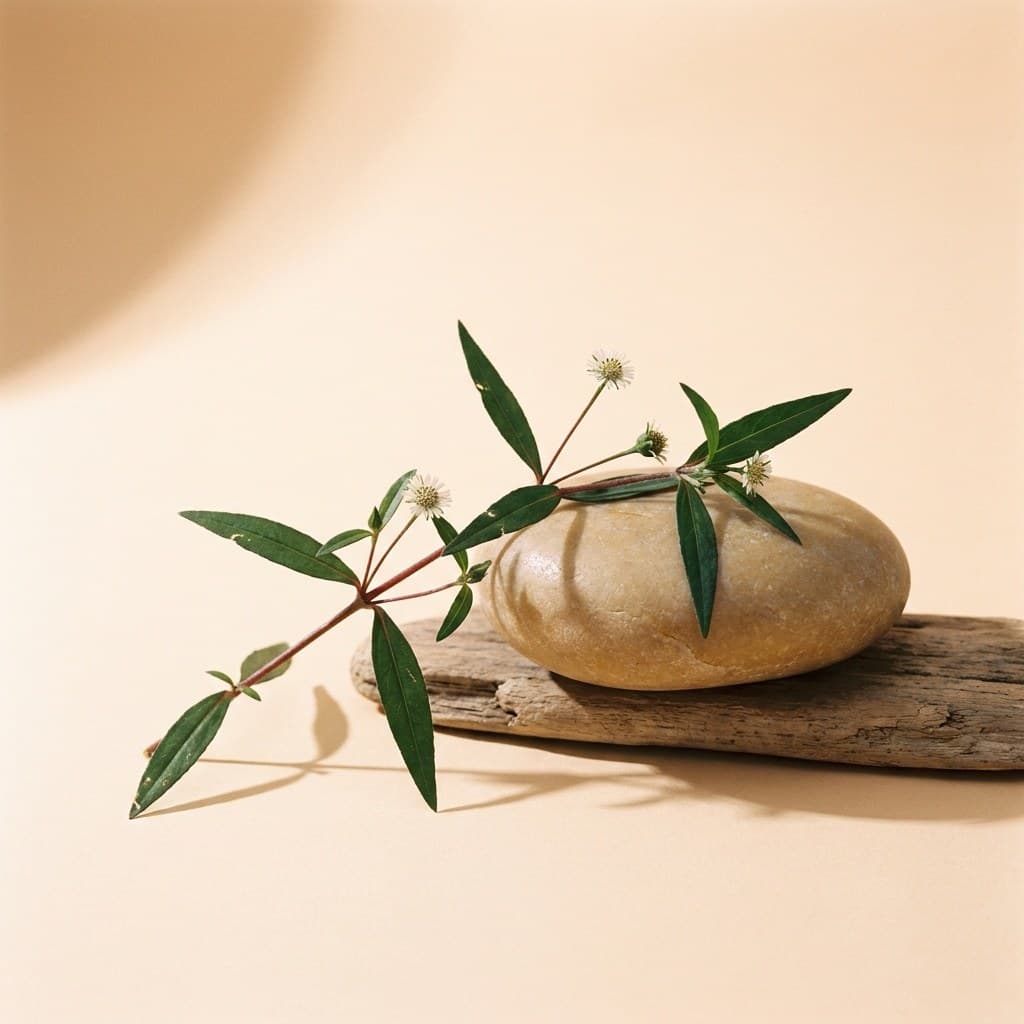
If tulsi is the queen of the courtyard, bhringraj is the king of the oil pot. This modest creeping herb with small white daisy-like flowers grows quietly along field edges and riverbanks across India, and yet the classical Ayurvedic texts crowned it 'Keshraj', the ruler of the hair.
No serious traditional hair oil is formulated without it. Ours is no exception.
In the classical tradition
Bhringraj appears throughout classical Ayurvedic literature as the definitive hair herb, traditionally prepared as a slow decoction in sesame oil. In the southern and northern traditions alike, bhringraj oil was the one reserved for the head: applied warm, massaged in circles, left overnight before a morning wash.
What it brings to your hair ritual
Bhringraj is the body of the formula. Hair oiled regularly with bhringraj looks richer and more substantial, with a deep natural sheen, the qualities that earned it the royal title. It pairs naturally with amla: one builds the look of body, the other polishes it to a shine.
Inside Tulsivedic Herbal Scalp Oil
We infuse the whole aerial herb, leaf, stem and flower, because the traditional preparations never used isolates. It is the deepest note in the blend, earthy and green, the foundation the brighter herbs sit upon.
Common questions
Why is bhringraj called the King of Herbs?
Classical Ayurvedic texts give it the title 'Keshraj', ruler of the hair, reflecting its unmatched standing in traditional hair preparations.
What does bhringraj look like?
A low, creeping herb with slender dark-green leaves on reddish stems and small white button-like flowers, a member of the daisy family.
Is bhringraj in every Tulsivedic bottle?
Yes. Bhringraj is one of the foundational herbs of the formula, present in every batch alongside tulsi, amla, brahmi and neem.
Six botanicals, one ritual
Meet them all in one bottle.
Tulsi, amla, bhringraj, brahmi and neem, steeped in cold-pressed sesame to one family recipe from Moga, Punjab.
Shop the Oil · ₹397