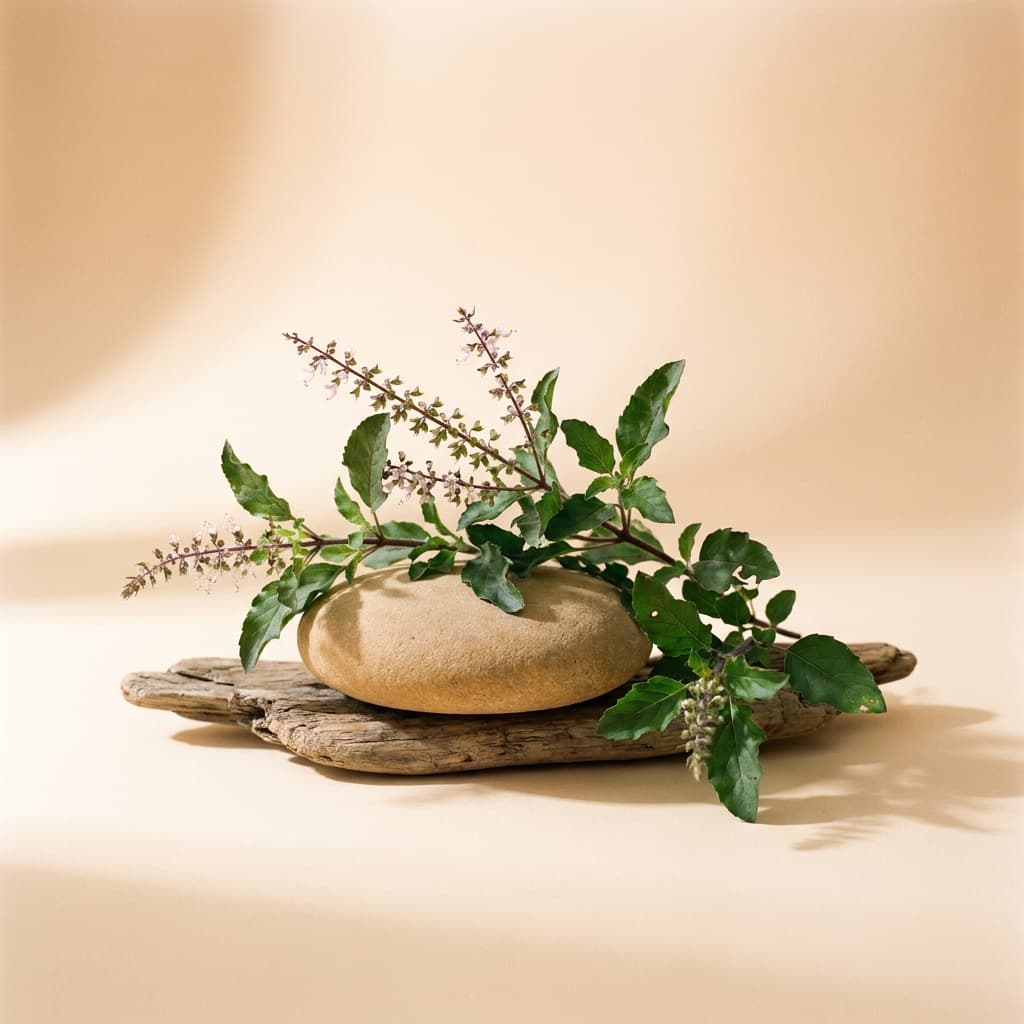
Walk into almost any traditional Indian courtyard and you will find a tulsi plant growing in a raised earthen pot at its centre. No other herb holds this position, literally and culturally, at the heart of the home. Tulsi, or holy basil, has been cultivated across the Indian subcontinent for well over three thousand years, woven into daily ritual, devotional practice, and the classical medicine of Ayurveda.
It is this heritage that gives Tulsivedic its name. Tulsi anchors our formula the way it anchors the courtyard: everything else is arranged around it.
In the classical tradition
Ayurvedic texts revere tulsi as a rasayana, a herb taken to support overall wellbeing, and call it 'The Incomparable One'. Its leaves carry a distinctive peppery-sweet aroma from naturally occurring eugenol, the same aromatic compound found in clove. In the traditional hair-oiling ritual, warmed tulsi-infused oil is massaged into the scalp at the start of the practice, prized for the clean, refreshed feeling it leaves behind.
What it brings to your hair ritual
Tulsi is the purifying note in the formula. Massaged into the scalp, tulsi-infused oil leaves it feeling clean, cool and balanced: the fresh canvas every good hair ritual begins with. Its herbaceous aroma is also the opening scent of Tulsivedic Herbal Scalp Oil: green, bright, and unmistakably alive.
Inside Tulsivedic Herbal Scalp Oil
We infuse whole tulsi leaves into our cold-pressed sesame base in small batches, slowly and at low temperature, the way it has always been done. No isolates, no synthetic fragrance imitating the real thing. Just the leaf itself, given time.
Common questions
Is tulsi the same as Italian basil?
They are cousins, not twins. Tulsi (Ocimum tenuiflorum) is a distinct species with a sharper, clove-like aroma and a long history in Ayurvedic practice, while culinary basil (Ocimum basilicum) is the one on your pasta.
What does tulsi smell like in the oil?
A bright, green, gently peppery top note that softens within minutes of application, settling into the warmer herbal base of the blend.
Why is tulsi called sacred?
In Indian tradition the plant is considered holy and is grown at the centre of the home courtyard, tended daily, a living symbol of care and protection.
Six botanicals, one ritual
Meet them all in one bottle.
Tulsi, amla, bhringraj, brahmi and neem, steeped in cold-pressed sesame to one family recipe from Moga, Punjab.
Shop the Oil · ₹397